The Destruction Caused by Sub-Floor Silt and Grit
The geography of Central Indiana features dense subsoil structures heavy in fine glacial sands, silt, and cohesive clay particles. While external French drains and geotextile filter fabrics are designed to hold back these materials, micro-particles continuously bypass filtration boundaries over years of heavy rainfall cycles. Swept along by hydrostatic water currents, this abrasive debris migrates straight into your basement's collection basin.
Once inside the liner, the heavy sediment settles at the absolute bottom, exactly where the submersible pump draws its suction. As the system activates, this grit is pulled directly into the tight tolerances of the impeller housing. The abrasive slurry grinds against the spinning vanes, causing severe mechanical resistance, wearing down critical seals, and ultimately locking the drive shaft completely solid.
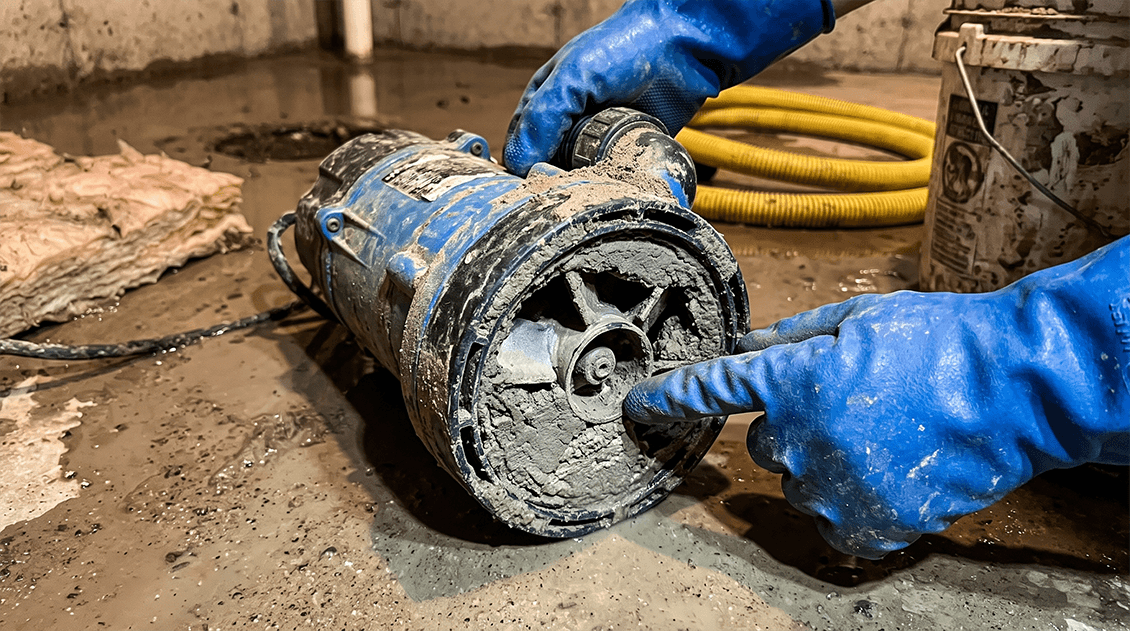 Accumulated fine sand and clay deposits choke the lower intake screen, blocking water volume and locking the mechanical impeller vanes.
Advanced Basin Evacuation and Unlocking Protocols
Simply pulling a seized pump out and replacing it without addressing the basin foundation is a temporary fix that leads to repeat failures. The independent field specialists routed through our network execute a thorough technical flushing process to clean out the sub-grade infrastructure:
- Silt Hydro-Vacuum Extraction: Utilizing heavy truck-mounted vacuum systems to completely evacuate the thick, abrasive mud and sand layers from the bottom of the plastic or concrete basin liner.
- Impeller Chamber Reconstruction: Manually stripping down the lower pump housing to extract bound gravel, stone chips, and mineral scale, ensuring the shaft spins freely without resistance.
- Weep-Hole and Discharge Cleaning: Clearing out localized relief ports and inline discharge lines to maximize fluid dynamics and guarantee unhindered water transit out of the property.
The Risks of Ignoring Shaft Resistance
When an impeller becomes jammed by debris, the electric motor inside the sealed housing continues to receive power. Unable to turn, the electrical energy converts entirely into extreme heat. Within seconds, this thermal overload burns out the motor windings, destroying the unit permanently. Don't wait for a terminal electrical short to ruin your backup systems—let a professional clear the sediment and secure your sub-grade drainage lines before the next big storm surge hits.