The Sub-Slab Hydrology of the Greater Indianapolis Region
The geographic foundation of Central Indiana features dense layers of glacial till mixed with pockets of highly permeable sandy loam. This unique combination creates a fluctuating water table that responds rapidly to seasonal storms. Residential and commercial concrete slabs across Marion County rely entirely on perimeter drain tiles to catch this rising water and redirect it into a sump basin pit. The mechanical pump inside that basin serves as your home's primary defense against water damage.
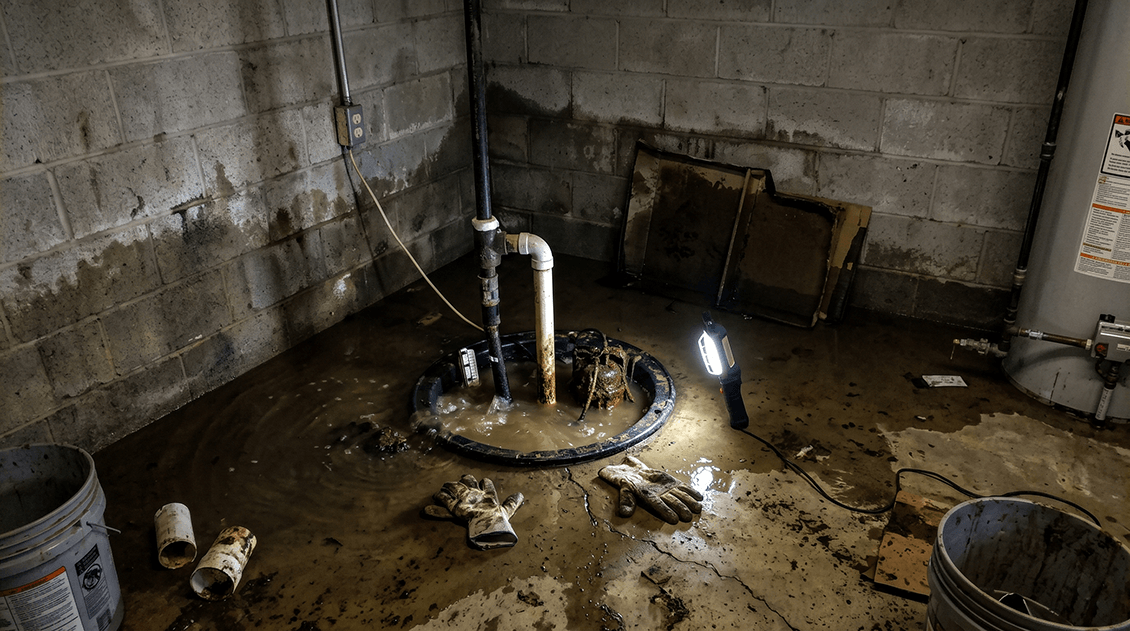 Hydrostatic groundwater pressure overcoming a locked submersible pump impeller assembly inside an Indy basement.
When heavy rains fall or winter snow thaws rapidly, the volume of water entering the basin can easily hit twenty to thirty gallons per minute. If the primary submersible pump suffers an electrical blackout, switch failure, or mechanical lock, that volume accumulates within the basin liner in under five minutes. Once it breaches the rim, it spreads out underneath subfloors and finished surfaces, creating an immediate structural emergency.
Psychrometric Classifications of Sump Basin Overflows
Under professional guidelines (IICRC S500 Standards), water entering a basement from a failed sump pump is classified based on its potential biological hazards. Ground water that collects in a foundation basin is categorized as Category 2 (Gray Water). This water isn't clean tap water; it carries agricultural chemicals, lawn fertilizers, and soil pathogens picked up as it filters through the ground.
If this water sits on basement floors for more than twenty-four to forty-eight hours, its classification changes dramatically. Rising temperatures and contact with organic building materials like drywall paper or carpet backing trigger rapid bacterial growth, turning the environment into Category 3 (Black Water). At this stage, cleanup requires advanced hazardous material containment and aggressive sanitization to make the space safe again.
Advanced Thermal Imaging and Moisture Mapping Techniques
Professional water damage restoration requires pinpoint accuracy. Simply drying visible surface pools covers only a fraction of the problem. Saturated concrete pores, wooden sills, and framing plates can hold onto moisture long after the standing water is gone, providing an ideal breeding ground for structural decay.
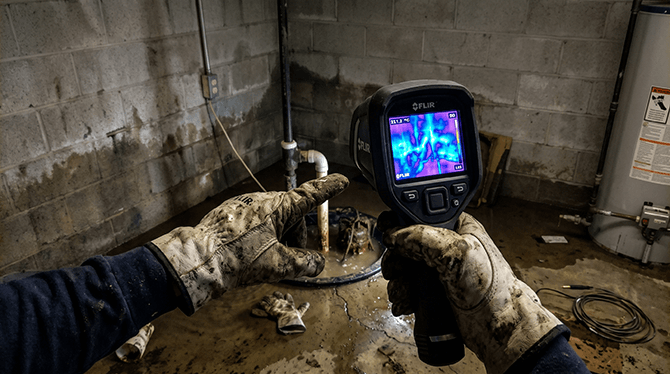
Dispatched technicians utilize non-invasive digital moisture meters along with FLIR infrared cameras to map out hidden water migration paths behind finished drywall and under floor coverings. These tools allow crews to detect temperature drops caused by evaporation, revealing exactly where water has traveled behind the walls. By pinpointing these hidden moisture pockets, teams can set up targeted drying systems without tearing down unaffected structural materials, saving homeowners time and money during the recovery process.
The Physics of Low-Grain Refrigerant Dehumidification
To safely dry a home after a major pump failure, crews must establish a precise vapor pressure differential between the wet building materials and the surrounding air. Saturated wood and concrete blocks naturally have high vapor pressure. By reducing the relative humidity of the indoor air, technicians can force trapped moisture to evaporate much faster.
Crews accomplish this by installing high-capacity industrial Low-Grain Refrigerant (LGR) dehumidifiers alongside high-velocity axial air movers. These advanced dehumidifiers cool incoming air below the dew point, allowing them to pull deep moisture out of the air even in cool basement environments. This continuous cycle drops the grains per pound (GPP) of the indoor air to safe levels, pulling moisture out of deep structural pores and preventing permanent warping, twisting, and splitting of framing timbers.
Streamlined Insurance Asset Protection and Reporting Folders
Filing a property insurance claim for a flooded basement can be a complicated process. Large insurance adjusters review these claims with a high level of scrutiny, often looking for gaps in documentation to limit payouts or deny claims entirely. This is especially true for water damage claims, where adjusters require clear proof that the damage was sudden and that mitigation steps were taken immediately.
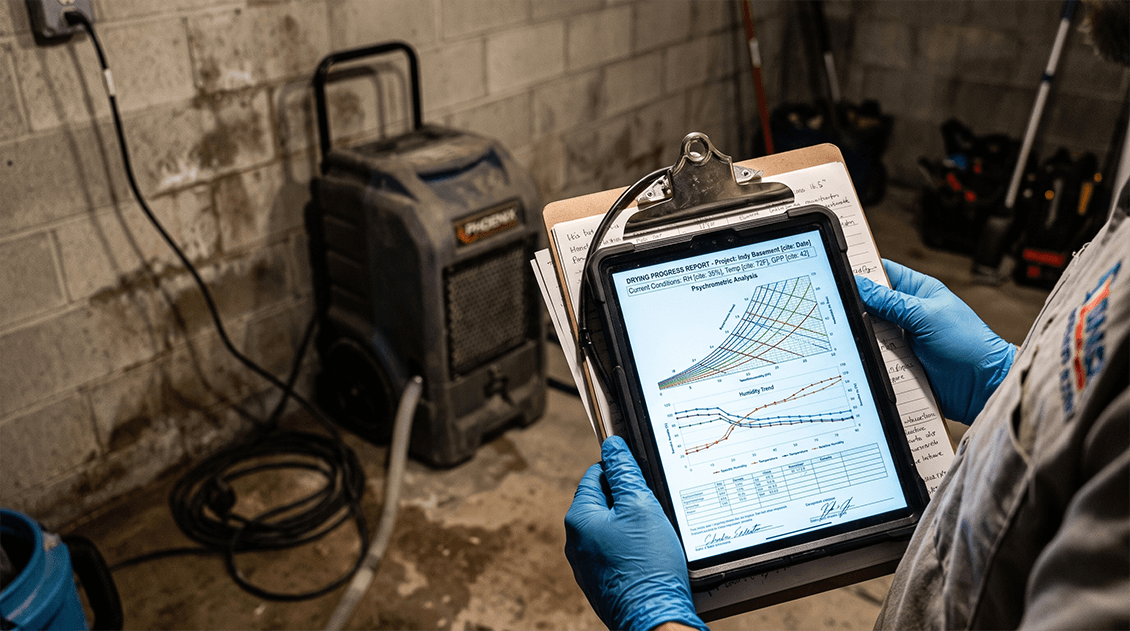 A restoration specialist in Indianapolis documents psychrometric data and drying progress on a digital clipboard to create an official record for real estate insurance claims, supported by professional drying logs.
The restoration professionals in our dispatch network provide complete, audit-ready digital documentation packages. These folders include initial thermal photos, daily drying logs, and final moisture verification charts that prove the property has been returned to safe industry dry standards. Having this detailed record package streamlines the claims process, helping you secure full compensation from your insurance provider without unnecessary delays.