The Mechanics of Sub-Grade Basin Overflows
Residential sump pump infrastructure is the primary barrier defending lower living spaces from hydrostatic groundwater accumulation. Under normal climate conditions in central Indiana, subsurface water tables maintain a predictable load. However, during rapid flash thaws or concentrated storms, groundwater vectors shift violently, forcing immense volume into the localized collection liner.
When a mechanical pump package experiences switch failure, electrical shorts, or a locked impeller assembly, the rising columns of water breach the basin perimeter in minutes. This is not clean surface water; it is heavy gray water rich in mineral deposits, organic sediment, and bacterial strains. Immediate high-capacity extraction is mandatory to minimize concrete masonry pore contamination and prevent sub-floor saturation.
Advanced De-Watering and Thermal Diagnostics
Our routed technical teams approach a basement failure utilizing strict, measurable stabilization patterns. Simply draining a flooded floor surface does not resolve the deep latent moisture locked within structural materials. Saturated block cavities and lower wall base plates act as sponges, pulling water columns vertically via capillary forces.
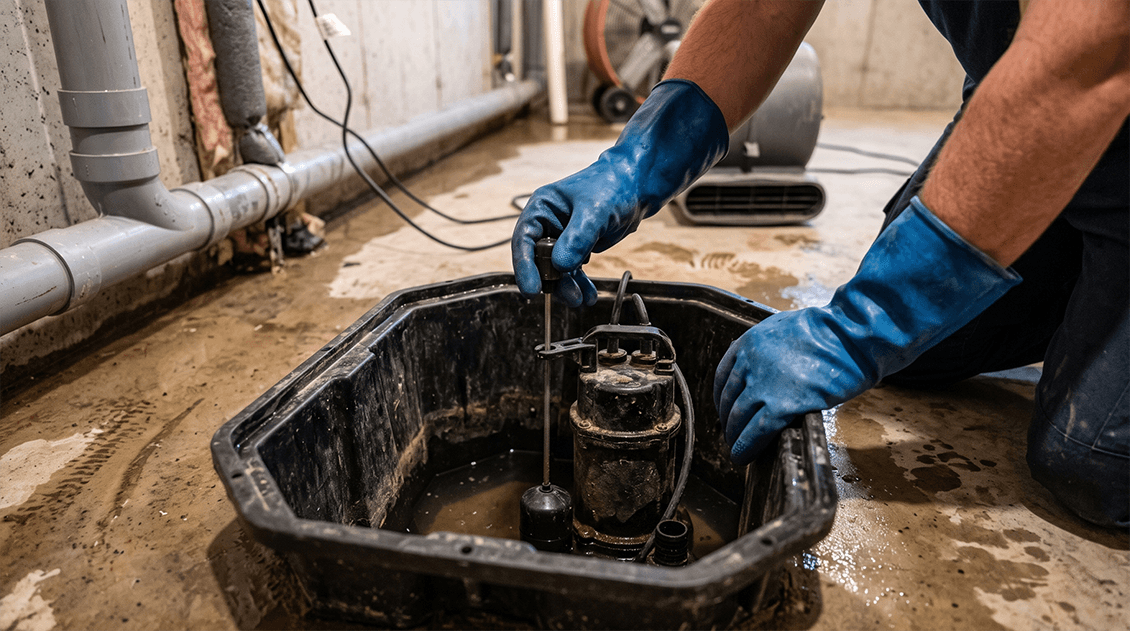 A regional field technician inspects and recalibrates a bound vertical float switch mechanism inside an overloaded sub-floor collection basin to re-establish emergency de-watering operations.
Industrial Evacuation & Mechanical Recovery Protocol
Upon arriving at a critical dispatch site, the assigned mitigation team deploys truck-mounted vacuum apparatus or high-head submersible trash pumps to rapidly empty the basement floor and clear the basin pit. Once the structural baseline is exposed, technicians execute a multi-point inspection to pinpoint why the system stalled:
- Mechanical Switch Evaluation: Assessing vertical float tracking arms and electronic tether contacts to correct binding or terminal switch burnouts.
- Impeller Chamber De-Trashing: Clearing trapped gravel, stone chips, and mineral scaling that lock up subsurface pump impellers and overheat drive motors.
- Check-Valve Integrity Auditing: Inspecting the inline discharge piping assembly to prevent backflow surges from evacuating water back down into the foundation envelope.
Preventing Long-Term Structural Defeasance
Leaving a sub-grade floor structure wet for more than 48 hours unlocks immediate avenues for deep organic decay and concrete degradation. Wood framing plates, sill timbers, and finished drywall materials lose their load capacity when exposed to prolonged saturation. Furthermore, high ambient relative humidity inside unventilated basements promotes airborne spore growth that can rapidly compromise whole-home air quality metrics.
The service providers on our network combat this through targeted thermodynamic moisture removal. By deploying rows of commercial axial air movers paired with industrial LGR (Low Grain Refrigerant) dehumidifiers, they pull water molecules directly out of the concrete substrate. This structured method preserves foundation values and ensures your home safely passes future real estate evaluations.